Showing posts with label Munich. Show all posts

Friday, November 21, 2014

Odeonsplatz

Odeonsplatz in Munich originates from the beginning of 19 century when Maximilian I Joseph agreed with plans of his son and heir (Ludwig I) to arrange this area. The idea was to make from Odeonsplatz central entrance to the city.

The Odeonsplatz inherited its name from the concert hall “Odeon”. In 1862 on this square was raised statue of the King Ludwig I designed by Max Widmann.

Munich. Odeonsplatz. statue of the King Ludwig I Photo provided by the Poco a poco under CC BY 3.0 license

Wednesday, November 19, 2014

Feldherrnhalle

Feldherrnhalle (or as it also called the Field Marshals’ Hall) stands on the edge between old and new city in Munich on the site of medieval tower which has been demolished in the 19 century.

This building has been raised to commemorate all heroes in Bavaria. You can see the statues of Count Tilly who was successful general in Thirty Years’ War and of Count von Wrede who was leading Bavarian troops in Napoleonic era.

Photo. Munich Feldherrnhalle

Also Feldherrnhalle has small memorial dedicated to the Bavarian army designed by Ferdinand von Miller the Younger.

Feldherrnhalle has been designed by Friedrich von Gärtner who modeled it after the Loggia dei Lanzi in Florence. The construction of Feldherrnhalle has been finished in 1844. In 1906 its staircase has been adorned by statues of lions.

Wednesday, November 5, 2014

Theatinerkirche Munich

This wonderful Baroque church has been built in 17th century by Elector Ferdinand to celebrate the birth of his son. The architect of the Theatinerkirche was Antonio Barelli from Bologna who conceived to build most decorated church in Munich.

Construction of the church began in 1663. Barelli chose Sant’ Andrea della Valle in Rome as prototype for its design. Also Theatinerkirche was planned as the court church for the Wittelsbach dynasty.

Theatinerkirche in Munich

Enrico Zucalli became a new architect in 1675 and under his leadership dome and two twin towers (which were absent in the initial design) of the façade were completed. He also designed the interior of Theatinerkirche.

Construction of the church lasted about the century and has been finished in 1765 under the supervising of Cuvilliés.

Theatinerkirche brought baroque elements into the cityscape. Its façade adorned by sculptures of famous Bavarian rulers and their coats of arms. Inside of the Theatinerkirche you can see stucco work and the statues which portray allegorical figures.

In the church’s crypt there are tombs of Bavarian kings. For example, the shrine of the Theatinerkirche founder – Ferdinand.

Interior of Theatinerkirche. Photo provided by the Harro52 under CC BY 3.0 license

Monday, November 3, 2014

Residenz Munich

History of Residenz in Munich began in 15 century. Ludwig of Bavaria decided to extend the city and, thereby, former Duke's castle appeared (Alter Hof) in the depths of the Munich. It was the bad practice in the Middle Ages to have castle inside of the city because in the case of the siege it was very hard to escape from it.

In 1385, Stefan Third began to build new castle in the north-eastern part of the city. Later this fortress has been merged with other residences of Wittelsbach in Munich and got the name – Residenz.

Renaissance facade of the Residenz

Visit to the Residenz will take a few hours from you. Complex comprises three museums: Museum of Residenz, Treasury and National Opera. I advise you restrict themselves by visiting of first two museums. As for Opera it will be better to visit it during the evening performance.

Also don’t forget to take the audio guide before you enter. Residenz has a lot of things which once belonged to Wittelsbach and audio guide will make you excursion more interesting.

Courtyard

It makes sense to walk around the complex before you visit the museums. His current guise Residenz took in 17 century and this is a nice example of the Renaissance in Munich.

Wittelsbachs were the big fanciers of ancient Greece culture. They were collecting Greek masterpieces and in 1568 for their storage Albrecht Fifth built special building - Antiquarium. Today – is a one of the most impressing buildings of Residenz.

fountain of Perseus

Antiquarium has more than 300 ancient sculptures and 1000 images of cities and castles of Bavaria. But before you enter to the Antiquarium you will pass through the artificial mainsail adorned by the fountain of Perseus.

Another astonishing part of the Residenz – is Gallery of Ancestors where you can see portraits of the members Wittelsbach dynasty.

Almost every Bavarian ruler was adding something new to the complex. Last modifications of the Residenz were done in 1826 when King Ludwig First joined new royal palace to the complex.

Antiquarium

rooms inside of the palace

gallery of ancestors

Friday, October 24, 2014

Siegestor

Like many others great cities in Europe Munich has own Triumph Arch or as it called here Siegestor. Arch in Munich has been built in 1843-1850 by designs of Friedrichvon Gärtner. If you have been in Rome you will probably find that the Siegestor reminiscent the Arch of Constantine.
Siegestor is also called the Victory Arch. It dedicated to the Bavarian Army and to the victories over the Napoleon. Interesting that Bavaria not always been the enemy of Napoleon; in some period of history it was his ally and frankly speaking Bavarian kingdom significantly enlarged own territories thanks to the Napoleon.

Siegestor

The arch is topped by the statue of Bavaria. It also decorated by reliefs which portray the battle scenes. Another interesting detail of the Siegestor – is an inscription which has been added to the arch in 1958 and reminds humanity that there is nothing more important that the peace in our planet.

Arch of Victory located on the facet between old and new Munich. When you pass through it you will notice the change of atmosphere. Just behind the Siegestor begins the business Munich with a lot of offices and buildings of 20th century. Of course you will find there cafes and restaurants, shopping centers and even the cinemas. In the evening the area around of Siegestor will propose you handful blues and jazz bars.

Wednesday, October 22, 2014

Max Joseph Platz

This square in Munich has been designed in 1820s by architects Karl von Fischer and Leo von Klenze. In the center of the Max Joseph Platz there is a monument dedicated to the first Bavarian king - Maximilian I Joseph who did a lot for his country.

During his reign the first Bavarian constitution has been accepted which was also the first constitution in the Germany. (Bavaria was the separate state in 19 century). As the Max Joseph Platz the statue also has been designed by the Fischer and Klenz.

National Bavarian Theater at the Max Joseph Platz in Munich

In front of the statue you can find the National Bavarian Theater which you can visit on the one ticket with the Residence. This ticket will not allow you to visit evening performance; to do this you will need to buy another one.

Theater has form of Greeke temple with interior designed in Classical style. It became known in the world thanks to the performances of Wagnerian operas. For example, it was the place were Tristan und Isolde has been performed first time.

Also Max Joseph Platz is circled by a lot of pubs were you can test traditional Bavarian food and beer. I think that after you visit the Residence you will find themselves happy by sitting in one of the local pubs.

Mounumnet of Maximilian I Joseph

You can find a lot of pubs inside of these buildings

Tuesday, October 14, 2014

Sendlinger Tor Munich

These city gates are the part of medieval fortifications of Munich which were built in 1285-1347 during the reign of kings Ludwig II the Severe and Ludwig IV of Bavaria. First time it was mentioned in 1318 and together with Isaator Gate it’s the oldest survived part of fortifications in the city.

Of course I can’t say that Sendlinger Tor did not change its guise. In the 1808 the gatehouse which once stood next to it has been demolished. Also the arches under the gate were not so wide as today. More precisely Gates had three different arches which in 19 century were joined to facilitate the city’s traffic.

Beyond the Sendlinger Tor there is a small wonderful Sendlinger Tor Platz which inherited its name after the Gates. Despite the fact that this is the one of transport hubs of the Munich, it’s a cased beautiful square which has the few nice restaurants.

The Sendlinger street which starts from this point was first street in Munich lined along the city’s walls. Btw, I forgot to mention that the “Sendlinger” means “sun holder” or “sun linger” if it’s good enough to translate in such way. Another mark of this area is a Matthew’s Church which originates from the Middle Ages. Like others churches in Germany it looks as new but don’t deceive themselves. It’s the old sight which was renovated few decades ago.

Sunday, October 12, 2014

Assam House

You can easily find this house by its lavishly decorated façade. Assam House (or Asamhaus) once belonged to the artistic Bavarian family and its name has been inherited from them.

In 1729 Assam House has been bought by the Egin Quirin Asam who had decided to convert it into the most artistic building in Munich. This was the first time in Munich when famous artist rebuilt house for themselves by its designs.

Asam adorned the façade of the house by the wonderful murals which depict allegorical scenes from antiquity. Unfortunately, it’s closed for public and you can’t explore how the house looks inside.

Assam House and Assamkirche. Photo provided by the BBKurt under CC BY 3.0 license

Viktualienmarkt Munich

This market got its name in 19 century when it was fashionable to name places in Latin manner. The word Viktualienmarkt means “goods and stocks”. The market has been transferred here from Marienplatz in 1807 by edict of Max I. Joseph who has decided to clear the traders out from the city's center.

From 1870 pavilions on the market become stationary; previously they were dismantled every day.

Viktualienmarkt - is an oldest market in Munich. It’s located next to the city center and very popular among the tourists. You can find almost all kinds of goods here from Spanish wines and to the fresh fishes from around the world.

Of course, I do not advise you refill your stocks here because prices in the Viktualienmarkt are very high.

But don’t miss your chance to try some local foods here. For example, famous Bavarian sausages and beer. You will find it very delicious.

Market is also known not only for its original purpose. If you visit the Munich during the city’s carnival you will find here a lot of celebrations including the famous dance of masked Viktualienmarkt’ sellers.

The fountain on the market has been erected to commemorate this dance and portrays cabaret artists.

Sunday, October 5, 2014

Isartor

Isartor – is a medieval city gates in Munich from the side of Isar river. The key feature of this sight is that Isator – is only the one untouched part of city’s fortifications. Generally, it looks exactly how it was in the 14 century.

Of course, in the 19th century Isartor has been adorned by added arches with friezes which depict the victory of Ludwig IV in the battle of Ampfing.

Isartor has three towers. Interesting small museum of Karl Valentin, a writer who wrote plots for films and spectacles is located at the southern tower.

Isartor in Munich . Photo provided by the Poco a poco under CC BY 3.0 license

Isartor in Munich . Photo provided by the High Contrast under CC BY 3.0 license

Friday, October 3, 2014

Altes Rathaus

Altes Rathaus in Minuch originates from the 1464. It was designed by Jorg von Halsbach who also was architect of Frauenkirche church. Despite the fact that Altes Rathaus later has been rebuilt few times, it saved its guise of 15 century.

Two gateways (you can see it on photo) were added to the building in 1877 and 1934 to facilitate traffic on the central Munich.

The building adjoins Toy Museum (Spielzeugmuseum) which is besides the oldest part of Munich fortification; it was built in the 12 century.

Inside of Altes Rathaus you can visit original Gothic ceremonial hall on the first storey of the building. Don’t miss there 96 carved coats of arms of noble Bavarian families.

Thursday, October 2, 2014

Peterskirche

Peterskirche or St Peter’s Church in Munich - is an oldest church of the city. It dominates over the historical center and you can make most wonderful photos from its belfry.

Peterskirche – is a cradle of the Munich. This church has been built in the 12 century and later city grew around it. We can even assert that church gave the name to the city since Munich translated as “monk”.

Of course original view of Peterskirche has not survived. In 1278-94 years church has been rebuilt and took the Gothic style. Its famous belfry was erected few centuries later.

Peterskirche . Photo provided by the Richard Huber under CC BY 3.0 license

Lavishly decorated interior of Peterskirche (its last version) was created in the 18th century. Church’s altar topped with St Peter statue which was created in 1492 Erasmus Grasser. Also note on the statues at the choir which were created in 16th century by Jan Polack. They portray the episodes of St Peter life.

Interior of Peterskirche . Photo provided by the Андрій Боссі under CC BY 3.0 license

Altar of Peterskirche . Photo provided under CC BY 3.0 license

Wednesday, October 1, 2014

Neues Rathaus

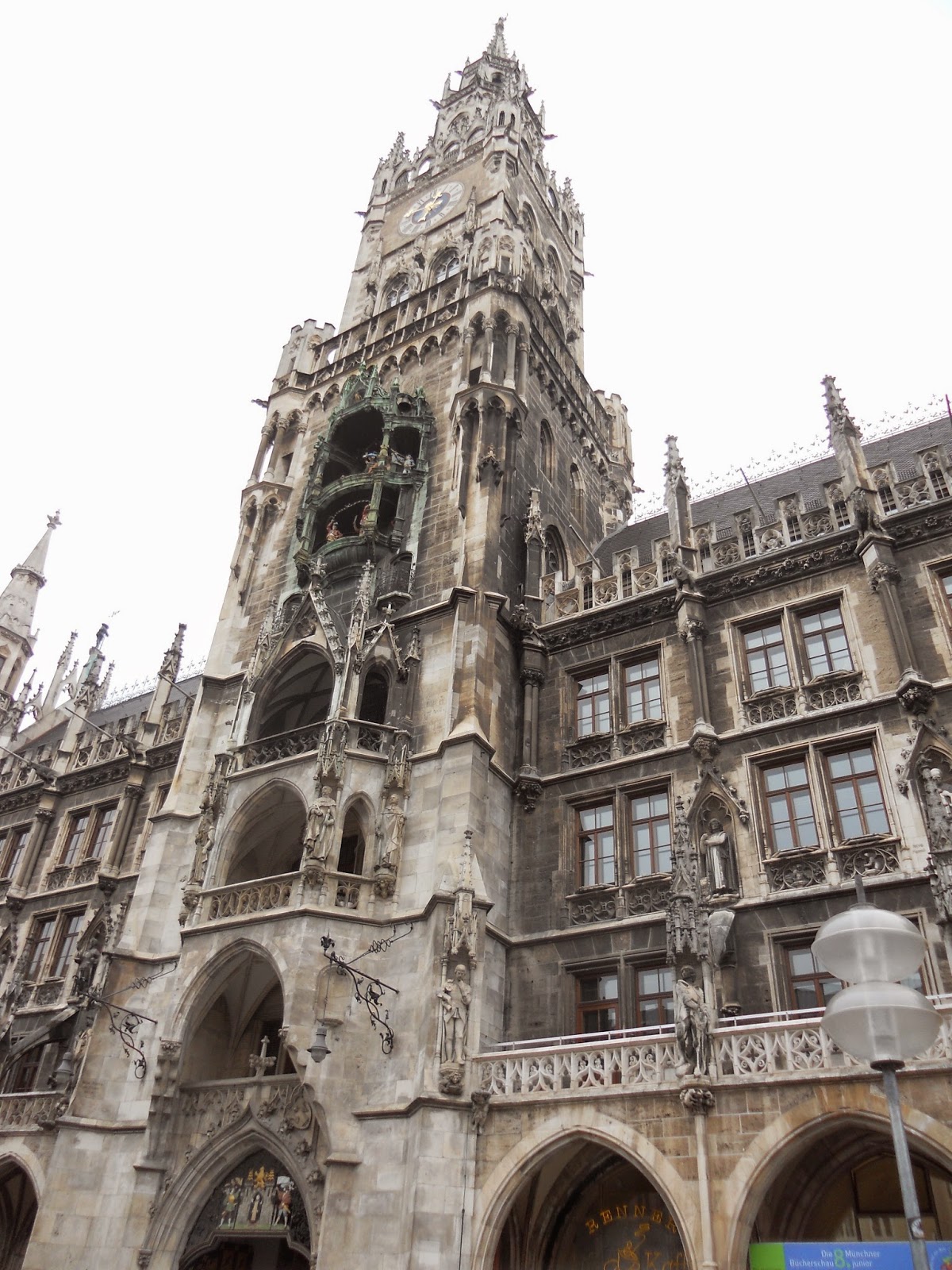
This astonishing building, one of the most beautiful in Munich, was built at the facet of 19th and 20th centuries. In 1867 the city’s authorities decided to build new spacious residence. For this purpose they chose a place at the south of the Marienplatz and destroyed 24 houses there.

Statues at the lavishly decorated façade of this Neo-Gothic building insinuate to the Bavarian history. They portray the saints and rulers of Bavaria in allegorical images.

Photo Neues Rathaus in Munich

Main tower of the Neues Rathaus is topped by symbol of the Munich; the bronze sculpture of the Munich Child (Münchner Kindl). And the clock of the watch tower is a one of the largest clocks in Europe.

Clock of the Neues Rathaus is adorned by the mechanical figures which are dancing every day two dances. During the first dance they portray a joust and another dance portrays the famous in Bavaria Dance of the Coopers which was dancing on the Munich streets in the Middle Ages.

Marienplatz

Marienplatz - is a heart and historical center of the Munich. In the Middle Ages this place was a main in the city. Here people gathered to hear the news, see shows, buy some products and discuss the most recent rumors.

In additional, Marienplatz has a gloomy fame since in the Middle Ages it was also an execution place.

Its current name square got in 1854 when people were pleading the Virgin Mary to protect them from disease. Since here was established a column to honor her they renamed the market place after her.

Photo. Marienplatz in Munich

Today Marienplatz is the most popular destination among the tourists in Munich. Especially in winter when here are conducting Christmas Market (Christkindlmarkt).

The most prominent monument of the Marienplatz – is Neues Rathaus (Town Hall) which originates from the middle of the 19 century.

Mariensäule (column dedicated to the Virgin Mary) was raised here in 1638 to commemorate the end of Swedish occupation of the city. The statue was created by designs of Hubert Gerhard in 1590 and column is work of Ferdinand Murmann.

Photo. Fischbrunnen

Another one sight of Marienplatz - is Fish Fountain (Fischbrunnen) which was created in 19 century. It’s generally accepted that if you put your purse in the water of the fountain during the Munich festival you will become extremely rich.

Saturday, September 27, 2014

Michaelskirche

This Jesuit church has been built in the end of 16 century by the edict of Duke Wilhelm V. It was the time of struggle between Reformation and Counter-Reformation and by construction of Michaelskirche Wilhelm had tried to foster Jesuits in Munich. Btw, it was a largest Renaissance church from north of the Alps.

Michaelskirche’s façade reminds the façade of Il Gesu in Rome which was a standard for all Jesuit churches. Of course church has own traits. On its façade you can see the statues of famous Bavarian rulers. Also don’t miss the statue of St Michael piercing the Dragon which was casted from bronze. This statue has been created by Hubert Gerhard in 1585.

Facade of Michaelskirche. Photo provided by the Bbb-Commons under CC BY 3.0 license

The interior of Michaelskirche is very spacious. At the choir of the church you can find altar decorated by Christoph Schwarz. One of his paintings portrays the fall of rebellious angels.

Michaelskirche is a shrine of some members Wittelsbach dynasty. Here you can find tombs of Maximilian I, Ludwig II and of course the Wilhelm V who was founder of the church.

Also behind the church you can find so-called Alte Akademie; college which has been built at the end of 16 century by Sustris.

Interior of Michaelskirche. Photo provided by the Harro52 under CC BY 3.0 license

Friday, September 26, 2014

Bürgersaal

This church in Munich has been built in 1778 by designs of Italian architect Giovanni Antonio Viscardi. Originally it has been contrived as a main church of Munich assembly and from it fact church got its current name – Bürgersaal

Behind the plain façade of this church you can find lavishly decorated two-storey interior.

Facade of Bürgersaal. Photo provided by the Bbb under CC BY 3.0 license

At the first storey of Bürgersaal there is a tomb of Rupert Mayer who gave his life to victory under the Nazis.

At the second storey don’t miss wonderful stuccowork by Joseph Georg Bader. Also you can find there paintings by Anton von Gumpp.

Unfortunately church was partly destroyed during the last war and some of its masterpieces were damaged. But after the war it was carefully restored. Among the survived arts is altar by Andreas Feistenberger which has been created in 1710.

Interior of Bürgersaal. Photo provided by the Andreas Praefcke under CC BY 3.0 license

Interior of Bürgersaal. Photo provided by the Andreas Praefcke under CC BY 3.0 license

Altar of Bürgersaal. Photo provided by the Andreas Praefcke under CC BY 3.0 license