Showing posts with label Florence. Show all posts

Saturday, September 13, 2014

San Lorenzo Florence

At first glimpse San Lorenzo in Florence seems insignificant. But don’t hurry to leave the place. Behind the plain façade of San Lorenzo there are a lot of precious masterpieces including those which were created by Michelangelo.

Also it’s treated as oldest church in the city. It’s generally accepted that San Lorenzo was built and consecrated in 393 before the fall of Roman Empire. The church was dedicated to the St Lorenzo and to the first Bishop of Florence – St Zino who was buried here.

Before the 7 century, when tomb of St Zeno was transferred to the Santa Raparta, San Lorenzo was a city’s Cathedral. In 1059 San Lorenzo took Romanesque shape. This construction stood untouched next four centuries when four wealthy citizens, including Giovanni de 'Medici, proposed their fund to refurbish it. In this enterprise Giovanni didn’t think only about to be backer; he thought to establish mausoleum for Medici family and enhance their power in Florence.

San Lorenzo. Photo provided by the sailko under CC BY 3.0 license

Three years after Brunelleschi become a head of construction in parallel with his immaculate work on the Cathedral. Construction of old sacristy has been finished shortly before the death of Giovanni de 'Medici in 1429. But soon after, process was slowed because in Florence began the era of political unrest. Situation became exacerbated in 1446 after the death of Brunelleschi.

Construction was resumed after the son of Giovanni – Cosimo Medici – supported it and donated to construction 40 000 florins. To give you idea of how big this sum was let me mention that sum of 150 florins was enough to support sheltered living in Florence.

Assigned as chief master, architect Antonio Manetti quickly had used all funds and in 1460 construction has been ended. Or to be more exact almost finished. Façade of San Lorenzo still not completed. In 1518 Pope Leo ordered Michelangelo to make façade but they didn’t come to consent of what marble should be used. As result it remains unfinished and looks ugly.

San Lorenzo. Pulpits by Donatello. Photo provided by the sailko under CC BY 3.0 license

Interior of San Lorenzo

When visitor comes to the church, first of all he becomes impressed by the Brunelleschi’s design. Despite the fact that San Lorenzo was one of the first works of Brunelleschi, he already showed here his immaculate talent.

Closest to entrance– is Marriage of the Virgin which was created by Rosso Fiorentino. Next to it magnificent murals of The Martyrdom of St Lawrence. It’s work of Bronzino which has been created in 1569. And don’t miss the bronze pulpits by Donatello which stands alongside. And keep in mind that it was his last work. And that Donatello has been buried here.

And of course the San Lorenzo is a resting place of Cosimo de’ Medici whose tomb stands at the center of the church. Note the inscription which is carved on the tomb’s surface – “Pater Patriae”. It’s title of Roman Emperors by which thankful Florentines had compared Cosimo's governing with Golden Era of ancient Rome.

Also inside the church you can see Roman sarcophagus, nice tabernacle, crucifix by Antonio del Pollaiuolo and many other masterpieces of Florence's art.

San Lorenzo. Marriage of the Virgin.

Interior of San Lorenzo. Photo provided by the Necrothesp under CC BY 3.0 license

Friday, September 12, 2014

Campanile Florence

Campanile in Florence is one of the most beautiful medieval towers in Italy. It was built according of Giotto’s designs and adorned by sculptures designed by Donatello and others great artists. The construction of Campanile began in 1334 under Giotto’s supervision who has been hired by Florence’s authorities for this job. Officially Giotto held title of “capo maestro”. But before his death in 1337 Giotto has finished only first tier.

After the Giotto’s death the work over Campanile has been under supervision of Andrea Pisano who just finished the work over Baptistery south doors. Pisano followed the Giotto’s blueprints and erected the second level of the tower. After Pisano the work over Campanile was continued under leadership of Francesco Talenti. He had not changed the original design of the tower but made corrections in construction’s calculations.

Campanila in Florence

The height of Campanila is 84.7 meters. Interesting that when it was finished in 1324, it bypassed the ban of Florence not to build very high towers in Toscana. This ban appeared in medieval Florence in times of civil war, when different districts of city waged war one with another. To fortify themselves they built high towers. To prevent fortifying of their power and influence, central authorities of Florence proclaimed special decree which prohibited to build high towers.

Façade of the tower is adorned by the statues which portray the plots of the biblical themes. These statues are work of Giotto and Pisano. But today visitor can see their copies; the originals are kept in the Museum of Duomo which located behind the Cathedral.

As in the case of the Dome of the Cathedral you can climb to the Campanile. But be prepared to this action. Campanile doesn’t have a lift so you will all job itself. And you should overcome 414 stairs to reach the top. Of cause you will be rewarded by the magnificent view of Florence below.

Campanila and Cathedral

Thursday, September 11, 2014

Dome in Florence

Most famous sight of Florence it’s Dome of its Cathedral. Lifting to it will give you unforgettable sense and experience; you will enjoy views of the city and the Dome itself. But be ready to spend in line some time. It’s very popular attraction among the tourists.

Dome in Florence has been contrived by the designer of Duomo - Arnolfo di Cambio. But Arnoldo didn’t explain how to build the Dome and left this task for shoulders of his heirs.

After the death of Arnoldo were a few attempts to finish it work. But they all were unsuccessful. For example, in 1367 master Neri di Fioravanti tried to implement Arnoldo’s ideas but all his attempts ended with mishap.

Dome in Florence. Photo provided by the Florian Decker, Messdiener Winterbach under CC BY 3.0 license

It was only one problem. To build Dome medieval masters used a lot of timbers to support structure until mortar will congeal. Arnoldo had contrived enormous Dome and to support it were needed a lot of timbers. To get it, Florence would to cut down all trees around the city.

It’s worth mentioning that many of masters tried to solve this problem and sometimes they generated extravagant ideas. One of them was to create a mound from mixture of earth and coins under the Dome to support it in hope that after Dome will be finished greedy Florentines will tidy it up.

In the end city’s authorities decided to declare tender and make this project open for public competitors. They did it in year of 1418. This tender has been won by the Filippo Brunelleschi who just returned to Florence from Rome where he studied the art of architecture. Interesting that Brunelleschi defeated his old rival Ghiberti to whom he earlier lost tender on creations of Baptistery’s doors.

Dome in Florence. Photo provided by the S. Scheele, Essen under CC BY 3.0 license

Ghiberti had not calmed with his defeat. He constantly tried to interfere Brunelleschi and criticized his work in attempt to be designated also to this job. In one day city’s authorities lent themselves to the Ghiberti’s pleas and made him co-chiefs of the project. But Brunelleschi refused to work together with Ghiberti and resigned. Ghiberti didn’t cope with his responsibilities and soon after Brunelleschi was called by authorities to complete the project.

Brunelleschi was successful not only because he devised revolutionary technology. He was very attentive to the tiny details of the project. For example, he established a kitchen and dinner room for his workers to facilitate the dinner for them.

Brunelleschi dedicated almost all of his life to this project. Few people in Florence believed that it would be possible to implement design of enormous Dome. But Brunelleschi undertook this project and finished it.

The final works on the Dome were completed on 1460s when Dome has been topped by the cross designed by Verrocchio.

View of Florence from the Dome. Photo provided by the Alboholic under CC BY 3.0 license

Wednesday, September 10, 2014

Ponte Vecchio

Ponte Vecchio is a one of the most famous landmarks of Florence. Current version of bridge will celebrate its 700 years birthday soon but bridge at this place stood since the Roman times.

In ancient times the bridge was on the Via Cassia road which connected Rome with a north Italy. During centuries it was only one structure which had connected two banks of the Florence.

When in 1117 bridge has been destroyed by another overflow, the city’s authorities allotted funds for building first stone bridge in Florence. That bridge stood next two centuries and has been destroyed during the flood of 1333. In 1345 began construction of current version of Ponte Vecchio.

Then bridge got its current name - Ponte Vecchio (old bridge). And it’s worth mentioning that in 14 and 15 centuries bridge was important part of the Florence’s fortifications. It protected city from the attacks from the river side.

Ponte Vecchio. Photo provided by the Cezar Suceveanu under CC BY 3.0 license

In 1565 Duke of Florence Cosimo the First ordered his architect Vasari to build concealed passage over the bridge to allow him defended pass from Palazzo Vecchio to Palazzo Pitti. Vasari did all work only for five months and was very proud of it. He also refurbished the bridge a little bit.

First shops on the bridge which you definitely will notice during you visit into Florence appeared here from its beginning. But initially there were mostly the shops of fishmongers who threw into the river entrails of fishes. We can only imagine the stench which was over the bridge.

Ponte Vecchio. Photo provided by the Javier Delgado under CC BY 3.0 license

No surprising that when Cosimo started to use passage he was exasperated by it and prohibited the fish selling here. After bridge was occupied by the tanners who used the river for soaking their hides. Finally Duke Ferdinando the First ousted all sellers from Ponte Vecchio and established on the bridge the set of jewelry shops. Many of famous Renaissance artists (for example Donatello) polished their skills in these shops.

In the 1900 at the middle of the bridge was established bust of Benvenuto Cellini to commemorate this master who also began his carrier at Ponte Vecchio.

To recap this story let me mention that in 1944 it was only the one bridge in Florence which has not been destroyed by the German troops which retreated before the advancing American Fifth Army.

Ponte Vecchio. Vasari Passagge. Photo provided by the sailko under CC BY 3.0 license

Saturday, September 6, 2014

Santa Croce

Santa Croce is a most majestic church of the Florence. I think it has more importance for the city than Cathedral or San Lorenzo Church. Even if not to consider the fact that interior of Santa Croce is adorned by the murals of Giotto and others famous artists, just keep in mind that this is Florence’s Pantheon. Here were buried such people as Galileo, Michelangelo, Machiavelli so if you want to pay respect to these names you definitely have to visit Santa Croce.

Santa Croce has been constructed for the Franciscans. The church was built by the design of Arnolfo di Cambio and under his supervision. Its construction began as 1294 and Santa Croce should was to surpass already built Santa Maria Novella – the main church of Dominicans.

Facade of Santa Croce

The construction was finished in 1385 but consecrated Santa Croce was only in 1143. Don’t be deceived by its façade. It’s more modern work which appeared here in 1863. Author of the façade stated that he found lost medieval design of Santa Croce façade. I can’t dispute that fact but also I can’t prove it also.

Franciscans, despite the fact that they obeyed to the strict rules of living and neglected the richness, spent a lot of money to build Santa Croce. The main source of the funds was an influx of the money from the bankers of Florence. Bankers donated great sums to the Franciscans. By that they thought that they are becoming closer to monks.

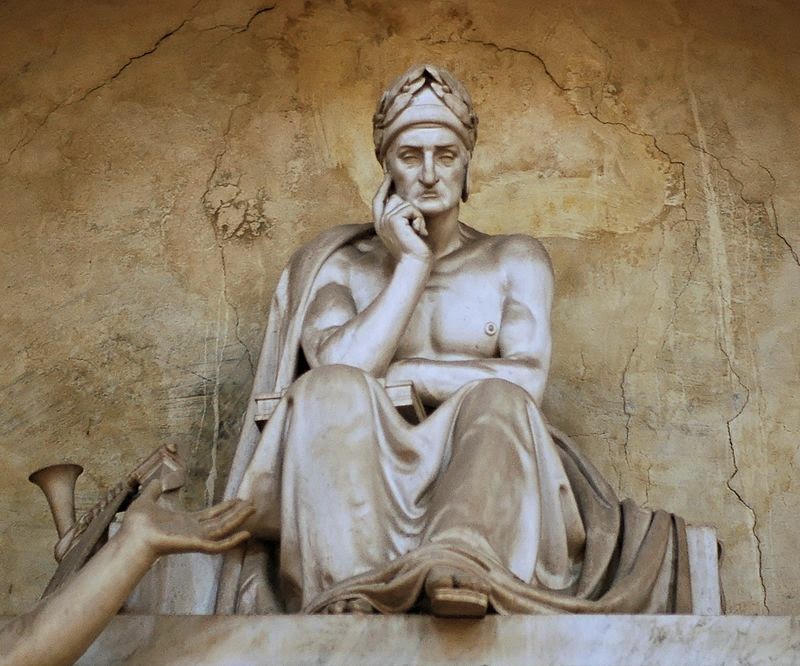
monument to Dante near Santa Croce

Thanks to such participants, Franciscans didn’t have scarcity of the funds to decorate Santa Corce and church has now one of greatest interiors in world.

Interior of Santa Croce

Michelangelo’s tomb. It was adorned by the beautiful relief by Antonio Rossellino. Photo provided by the Alboholic under CC BY 3.0 license

Next to Michelangelo’s tomb there is Cenotaph Dante. Great poet died on the north Italy in the city of Ravenna. He has been evicted from the Florence by his political rivals. Photo provided by the Jastrow under CC BY 3.0 license

Machiavelli’s monument seems very simple. It was created in 1787 after the two centuries of his death. The monument consists one inscription – “Tanto nomini nullum par elogiom” (There is no reward which is worthy this man). Photo provided by the Wknight94 under CC BY 3.0 license

Santa Croce possesses few greatest artistic masterpieces of Renaissance. Special place among them hold murals created by Giotto. You can find them at Bardi Chapel and Chapel Perutz which reside in the central nave of church. Murals were dedicated to the lives of John the Baptist and St. Francis.

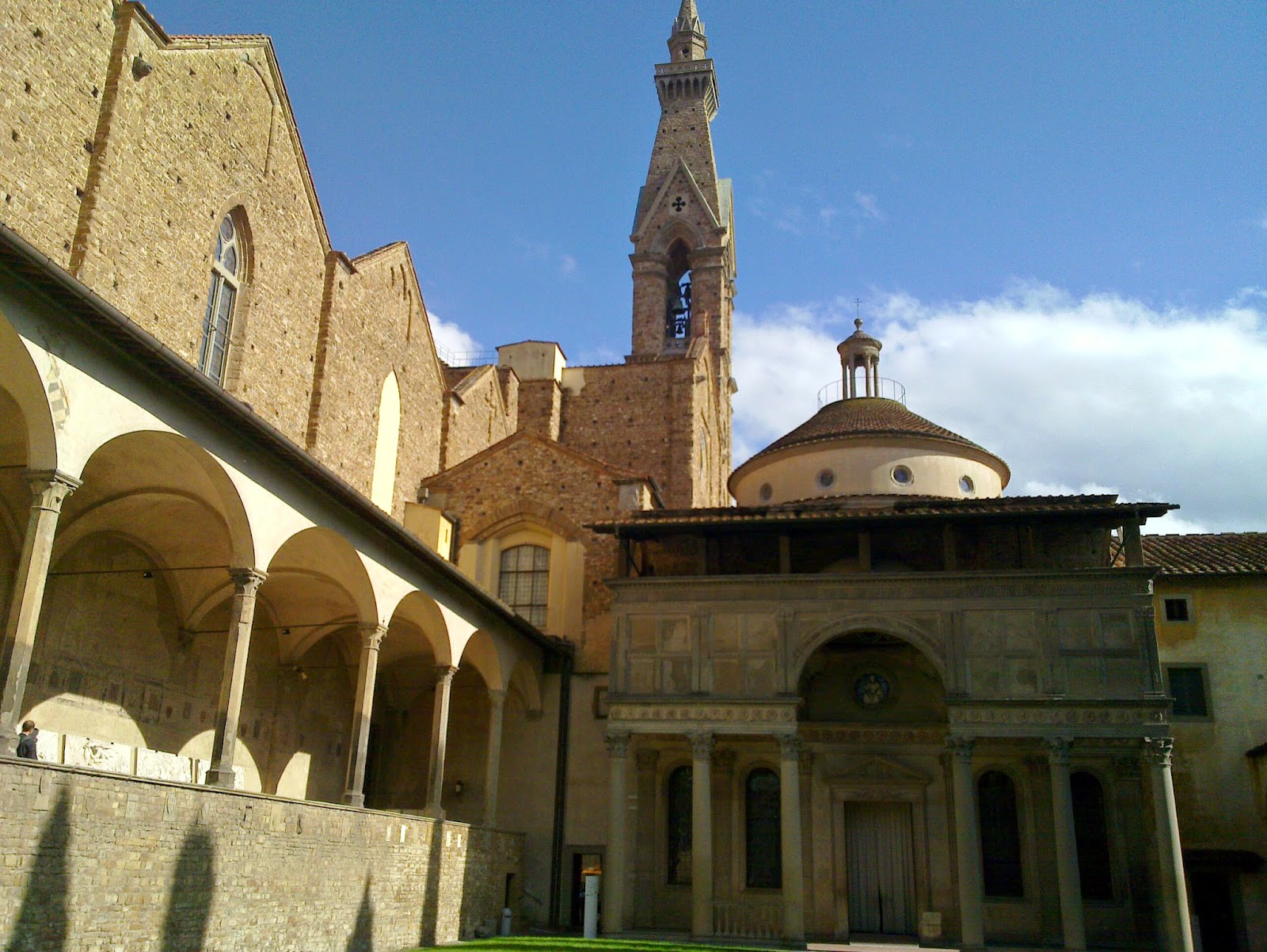
Inner yard of Santa Croce

To recap this article, I want to say a few words about the Santa Corce Square. This square is interesting because in the Middle Ages here were conducted football games.

Of course, those games were far away from what we know as football. Teams have had the ball but they didn’t have any rules. Players could do almost anything to get the ball.

Orsanmichele

Orsanmichele looks like rather as castle than church. Its name church got from the old “San Michele ad Hortum” which stood at the garden of the abbey.

Near 1290 next to the abbey was constructed loggia for grain trade. Abbey has been demolished but the remains of the garden’s church have been preserved thanks to great and revered icon of The Virgin Mary which has been kept inside. Next decades this loggia has been redeveloped few times and in 1380 its first level was converted to the church. The rest of the building continued to serve as granary.

Orsanmichele. Photo provided by the Tubantia under CC BY 3.0 license

In 1339 the decoration of the Orsanmichele was given to the Florence’s guilds.

Each of the guilds was responsible for hiring master and payment of his work. But guilds did not hurry to undertake their responsibilities. Only a 70 years after they began to heed to it. And may be it’s not bad because their activity matched up with flowering of Renaissance in Florence.

Total in niches of Orsanmichele there are 14 statues; some of them is a modern copies. First what attracts your attention when you come inside of Orsanmichele – are amazing murals which portray the saint backers of the guilds.

San Giovanni Battista was created by Ghiberti to accomplish the order of the guild “Arte di Calimala”. The heads of this guild were assured that it’s impossible to do such enormous statue. So they warned Ghiberti that in case of mishap he will pay alone for all expenses. But Ghiberti did prefect work. Photo provided by the Utente:Elenasan under CC BY 3.0 license

Interior of Orsanmichele. Photo provided by the Sailko under CC BY 3.0 license

Thursday, September 4, 2014

Boboli Gardens

Best park of Florence, so called Boboli Gardens, located behind the Pitti Palace. This garden, one of the biggest gardens in Italy, has been created in 1549 by decree of Duke Cosimo First. In 1756 garden was opened for public visits.

If to move through the park from west to east, you can see the Fort Belvedere and one of the three park’s grots, grot Bonatelli with sculptures designed by Michelangelo. Next to it you can see “Bathing Venus” and “Paris and Elena” which were designed by Giambologna and Vincenzo de Rossi, respectively.

Boboli Gardens. Photo provided by the LELE 87 under CC BY 3.0 license

In the summer time you can visit so called coffee-house which originates from 1776. One of the most unusual constructions in the park – is a fountain of Bacchus which portrays Cousimo’s clown on the back of turtle. This statue stands in the small bath surrounded by different sculptures.

To the south of it you can find the Amphitheater which initially served as source of the building materials for the Pitti Palace and later was converted to theater. It’s place where were conducted first operas in world. To the east from the Amphitheater you can find a big alley cased by the cypresses. This alley ends by the Piazze dell’ Isolotto which was created in 1618. At the center of the square you can find the sculpture created by Giambologna.

Boboli Gardens. Photo provided by the sailko under CC BY 3.0 license

Boboli Gardens - Isolotto. Photo provided by the sailko under CC BY 3.0 license

Boboli Gardens - Coffe House. Photo provided by the sailko under CC BY 3.0 license

Boboli Gardens - Bathing Venus. Photo provided by the sailko under CC BY 3.0 license

Sunday, August 31, 2014

Florence Baptistery

Probably, Florence Baptistery (Baptistery of Saint John) is oldest building in the Florence. During a long time the citizens of Florence had believed that this building has been built in the 1 century BC and was a Temple of Mars before it was converted into the Christian Church.

It is generally accepted that Florence Baptistery has been built over the ancient structure, probably the big roman house of the first century. There is also a big probability that ancient marble columns of Baptistery were brought here from the Florence’s Capitol.

First time Florence Baptistery appeared in the documents in the 897. It was mentioned as the city’s Cathedral. Many of its decorations are dated between 1059 and 1128, when it has been reconstructed and refurbished. The decoration of Florence Baptistery was ordered and paid by the Merchant Guild (Arta di Calimala) which in medieval Florence was responsible for keeping it in the good conditions.

Also it’s worth mentioning that in Baptistery (not the Florence’s Cathedral) are kept most valuable examples of medieval art in Florence, including magnificent murals.

Mosaics in Florence Baptistery. Photo provided by the Geobia under CC BY 3.0 license.

One of the most attractive things of the Baptistery - it’s its doors. First appeared south doors which were made by designs of Antonio Pisano. Before he has been hired to this job, Antonio finished the similar work in the Pisa and deeply impressed the city’s authorities by it. So they have decided to give this job to him.

Only for a three months Antonio modeled the wax sculptures for the doors, casting of which was entrusted to the Venetian master Leonardo d’Avanzo; in those times Venetians were known in Europe as not surpassed masters of casting. The casting lasted for a six years and final work has been installed in 1336.

South doors of Florence Baptistery. Photo provided by the sailko under CC BY 3.0 license.

By the creation of the north doors the city’s authorities hoped to avert the epidemic of “Black Death” from Florence. This time the candidate for this job was not obvious and the city’s authorities launched a tender for this job. Among others works they opted the works of two young artists - Lorenzo Ghiberti and Filippo Brunelleschi and proposed them coherent work. But Brunelleschi had relinquished the proposal; he went to Rome instead and studied the art of architecture.

Next twenty years of his life Ghiberti devoted for the work under the north doors. As result, artistic masterpiece appeared which consisted from 28 panels with reliefs.

North Doors of the Florence Baptistry. Photo provided by the sailko under CC BY 3.0 license.

Arta di Calimala was very impressed by the work of Ghiberti. Soon after he finished the north doors they ordered him to design and develop east doors. And Ghiberti created one of the best masterpieces of the Renaissance. Later Michelangelo said that these doors are “Gates of Paradise”.

It’s worth mentioning that original Ghiberti’s doors are kept in the Museum of Cathedral. In the 20 century they have been replaced by the copy. It’s not propogated information so you have a great chance to see it alone.

Gates of Paradise of the Florence Baptistry. Photo provided by the sailko under CC BY 3.0 license.

Saturday, August 30, 2014

Santa Maria del Fiore

Santa Maria del Fiore not always was a city’s cathedral. Once upon a time this role has been incumbent to the Baptistery and San Lorenzo while in place of Santa Maria del Fiore has been small Santa Reparto church which was built in 7 century.

The idea of building new Cathedral in Florence began to discussed at the end of the 13th century when the city’s authorities decided to highlight the growing power of the Florence. It’s worth mentioning that by that time the Florence’s rivals, including Pisa and Siena, already had Cathedrals and for Florence’s Council it was very important to surpass them.

City’s Council made decision that Santa Reparto “is too small and is too rough” for such great city as Florence. In 1294 council unfolded edict to build new cathedral which would have delighted by its richness and greatness. In the same year Arnolfo di Cambio got the order to develop the plans of new Cathedral.

Cathedral’s façade is comparatively new creation. In 1587 original façade designed by Arnolfo di Cambio has been dismantled but new façade appeared only 300 years after. It’s work of Emilio de Fabris.

As one of the traits of Cathedral, Arnolfo di Cambio contrived a big dome but he didn’t explain how to build it. Thus this task has been postponed for the further generations.

First stone of Cathedral has been laid in September of 1296; to emphasize connection between The Virgin Mary and Florence it got the name - Santa Maria del Fiore.

After the death of Arnolfo di Cambio in 1302, the work has lingered but it got new incentive when to the unfinished Cathedral was moved the body of St. Zinoviev. Then the work under Cathedral has been entrusted to the Giotto who devoted most of his energy to build Campanile.

After the Giotto, on the Cathedral’s construction worked a few architects who worked in the conditions of political and financial unrest in Florence. Nave of the Cathedral has been finished in 1378, arch – in 1380, the Dome of the Cathedral – it’s different story which I’m going to tell in the special article.

Requirements of the Florence’s Council to build spacious building have been taken by the Cathedral builders with great enthusiasm. They built the fourth largest Cathedral in world which can accommodate 30 000 visitors.

Interior of Florence's Cathedral. Photo provided by the Luca Aless under CC BY 3.0 license.

In the interior of the Santa Maria del Fiore there are few interesting murals. One of them dedicated to the great son of Florence – Dante. This mural located on the north nave of the Cathedral. It was created by Domenico di Michelini in 1465. Note that Dante has been depicted here out of the city walls. It’s a clue that he has been ousted from the Florence by his political rivals.

Florence’s Cathedral has more stained windows than any other Cathedral in Italy.

Judgement by Vasari. He painted Dome of Cathedral in 1579. Photo provided by the Arnaud 25 under CC BY 3.0 license.

Thursday, August 28, 2014

Palazzo Vecchio

Palazzo Vecchio dominates over the Piazza della Signoria in Florence. Its construction began in 1299 probably by designs of Arnolfo di Cambio. Here had gathered the city’s Council and in 1540 Palazzo Vecchio become the residence of Duke Cosimo First.

After the 9 years Cosimo moved his residence into Palazzo Pitti and then the building gained its current name (word “vecchio” means “old”).

Today Palazzo Vecchio again hosts the city’s Council but most of its space is open for public. Entrance to the Palazzo Vecchio lies through the internal yard which has been built in 1453 by designs Michelozzo and later adorned by Giorgio Vasari on the occasion of marriage between Francesco de 'Medici and Johanna of Austria.

Internal yard of Palazzo Vecchio. Photo provided by the TK Vanacoro under CC BY 3.0 license. Fountain in the center is a work of Andrea del Verrocchio who was a teacher of Leonardo da Vinci. It was moved here from Medici's villa in Caredgi

Palazzo Vecchio - grand hall. Photo provided by the Eusebius under CC BY 3.0 license. Salone dei Cinquecento has been developed to conduct the meetings of city’s Council. The walls of hall were adorned by Vasari’s murals which are devoted to the glory of Florence.

Giorgio Vasari - Defeat of Radagasio below Fiesole

Palazzo vecchio, michelangelo, genio della vittoria. Photo provided by the sailko under CC BY 3.0 license. You can find this Michelangelo’s work in front of to entrance to the grand hall. Nephew of Michelangelo gifted this statue to Cosimo, who ordered Vasari install it in grand hall to commemorate Florence’s victory over Siena

Studiolo di francesco I. Photo provided by the sailko under CC BY 3.0 license. Srudio di Franseco is a former private room of Cosimo’s son. It was adorned by the common effort of 30 artists

Wednesday, August 27, 2014

Piazza della Signoria

Piazza della Signoria was a center of political life in medieval Florence. Here located the Palazzo Vecchio where a few centuries earlier gathered the city’s authorities.

Initially Piazza della Signoria was located near the ancient center of Roman Florence. Next to it were the Roman Theater and city’s therms and at the south side Piazza della Signoria bordered with so-called fullonica, place where Romans colored textiles.

All Roman buildings, including the San-Romalo church, disappeared with time without any vestiges. They were demolished or dismantled to support other buildings.

The history of emerging of square related with legend. They say that the lands of Piazza della Signoria belonged to the Uberti family which didn’t support any movement in medieval Florence (city was divided to the two parties: Guelphs and Ghibellines). When family lost its influence in the city the lands were confiscated and all buildings were destroyed. With time all land has been paved to prevent Uberti restore their buildings.

Its current shape Piazza della Signoria took as result of sporadic and chaotic development. Any planning and laying out of the square began only in 1307 when city’s authorities gave part of the land to build Palazzo Vecchio. Curiously enough that written sources of 14th century mentioned Piazza della Signoria as a spot of construction rubbish.

Next time Piazza della Signoria has been remodeled after 1560 when Duke Cosimo First rebuilt Uffizi Gallery and in 1871 when Loggia dei Pisani has been destroyed.

First of all Piazza della Signoria attracts attention by sculptures and Loggia della Signoria. Each sculpture of Piazza emerged on the square to commemorate certain historical event in the life of Florence. If you reach the Piazza from the side of Duomo first statue you will face will be the statue of Duke Cosimo the First by Giambologna. This statue is reminiscent the statue of Emperor Marcus Aurelius in Rome and thus connects the Florence with the glory of ancient Empire.

Next time Cosimo appeared on the Piazza in the image of Neptune in fountain “Fontana del Nettuno”. This work of Bartolomeo Ammanati was ridiculed by Michelangelo who said that Ammanati just spoiled marble. Residents of the city assert that this statue prowls over the city in the full moon nights. And next to it there is a stone with inscription that here was burned Savonarola in 1498.

fountain “Fontana del Nettuno”

Most of sculptures of the square are copies. Their originals are kept now in museums of Florence. But here, at the Piazza della Signoria you can see them all and envision how place looked a few centuries ago. Loggia dei Pisani has been built in the 1376 by designs of Jacopo di Cione to protect the city’s authorities from the bad weather during the public events. Later the building was used for reception of envoys and for accommodation of mercenaries.

Today the Loggia is a small museum of sculpture under the open sky. Most famous exhibit of the museum is a “Perseus” of Benvennuto Cellini who worked on it during ten years.

copy of David

Loggia dei Pisani

“Perseus” of Benvennuto Cellini