Showing posts with label Crete. Show all posts

Monday, December 1, 2014

Cave of Zeus

Cave of Zeus located at central part of the Crete on the slopes of Ida Mountains. It’s located in the picturesque place at the altitude of 1538 meters near the alpine meadow.

Don’t forget about alpine climate here. Even in the peak season of the summer the temperature near Cave of Zeus does not exceed 16-18 degrees above zero. So when you are planning your visit here don’t forget to take warm clothes.

This cave called The Cave of Zeus because according to the legends here Rhea hid Zeus when he was young from his father Cronus.

Photo Cave of Zeus

From the ancient time cave has been used as sacred place. Here was a temple dedicated to Zeus. During the archeological excavations here were found a lot of precious exhibits which today can be seen at Archeological Museum of Crete.

To recap my small essay I want to mention that from Cave of Zeus are starting few mountain routes. Also you can find small hotel nearby.

Photo Alpine meadow near Cave of Zeus

Tuesday, November 25, 2014

Keras

Keras monastery located near the eponymous village at an altitude of 650 meters. This monastery one of the most wonderful on Crete. It has been founded during the second Byzantine period and has murals which are dated by the 14th century.

During the Turkish ruling the Keras monastery was the rebel’s mainstay. It was the real fortress which reliably blocked the pass into the Lasithi plateau. But during the World War II, German troops established a jail on the territory of monastery.

Photo. Keras Monastrey

I personally remember Keras as a picturesque place with nice views to the Crete seashore below. It’s quite and tranquil site where you can rest a little bit after hard walk on nearby mountains.

Monday, November 24, 2014

Lasithi

Lasithi plateau is the most fertile region on the Crete. It’s located on the eastern part of the island at height of the 850 meters over the sea level and all what is cultivated on Crete growing here.

The main sight of the Lasithi it’s thousands windmills which have been used to deliver water on the fields. Many of them are demolished now since today electricity is more used but they make picturesque view of plateau.

Lasithi plateau

The main village of Lasithi is Dzermiado which originates from the times of Venetian power on the Crete. But area around it was inhabited since Minoan era what is confirmed by many archeological evidences.

The main archaeological site of Lasithi is a Psychro Cave – the place where according the legends Zeus has been born. It was discovered in 1900 and during the archaeological excavations a lot of artifacts like ancient weapons, statues of gods, vases were found. Today they kept in the National Archeological Museum of Crete.

Windmill

Another interesting place of the Lasithi is Karfi which located on the north from the Dzermiado village. It’s Minoan settlement which dated by 12 century BC. Unfortunately there is no highway to this place so you will need to overcome the distance on your feet.

And of course don’t forget to visit local restaurant and test Greek food, for example, chopped lamb or Greek salad.

Monday, August 11, 2014

Rethymno

The city of Rethymno located on north shore of Crete. It’s one of the best preserved medieval cities in the Greece with well preserved architectural ensemble of the 15 century.

Rethymno does not have good beaches inside but the city is a popular resort because nearby there are a lot of great beaches with a big number of hotels. Public transport on the Crete is well developed and you can easily reach the city from your hotel by using the bus.

Despite the fact that most people think about Rethymno as about medieval city, it’s has own roots in dark era of the birth of the human civilization. You can make sure of it by visiting the local Archeological museum or by reading the Roman historians Claudius Ptolemy and Pliny. Also there is very interesting witnesses of the Claudia Eliana who wrote that in Rethymno was wonderful temple dedicated to the Artemis.

Photo port in Rethymno

Unfortunately we don’t have a lot of evidences about the Rethymno in the period of the Byzantine Empire and the Arabs.

In 961 the city was captured by the Nicephorus Phocas and after that Rethymno was a part of Byzantine Empire until the 1204 when Crusaders took control over the Crete. The era of Crusaders didn't lasted for a long period. They didn't leave any prominent signs of their presence on the island. Soon after, they sold the island to the Venetians and for Rethymno new era began – the era of Venetians.

Photo Old houses in the center

It was the most prominent era in the history of Rethymno. Most prominent monuments like Rethymno fortress and harbor were built in this period. Another prominent vestige of the Venetians is an Arkadi abbey which is located at the distance of the 10 km from the city.

After the fall of the Constantinople in 1453 Venetians have started wide fortification program on the Crete. Among the other projects they also began the project of building new walls around the Rethymno. This project has been finished in the 1570.

Photo view of Rethymno

May be it will be funny but just a year after, the Rethymno has been sacked after the dashing attack of the Turkish pirates. This induced the Venetians to build the fortress on the top of the Palaeokastro hill. The work under the fortress started in 1573 and was finished in 1590. But the territory of the new fortress was too small and could not include all houses in the city. Only administrative and military buildings were laid out inside the fortress. The rest of the buildings in Rethymno were left outside the fortress.

Photo garden in Rethymno

Fortress in Rethymno

Fortress of Rethymno doesn’t have military fame. In 1645 Turks have landed near the city of Chania and started conquest of the Crete. 29 September 1646 they have approached to the walls of Rethymno.

The head of the Venetian armed forces have decided that the defense will be meaningless and capitulated. There of, one of the most fortified fortresses of the 17th century has been given to the enemy without any resistance.

Today the walls and bastions of the citadel are in the good conditions. You can climb to it and take a walk over the wall’s perimeter. Also you can take in the military depots, Bishop's Palace and Mosque of Sultan Ibrahim.

Photo Fortress in Rethymno

Venetian port in Rethymno

Another significant Venetian landmark in the city – is an old port. Today port hosts a lot of fish restaurants where you can test a local sea food. The port of Rethymno is alo the heart of the old city. All paths start from this point and at the end they lead to the port.

Fountain Rimondi

This landmark located at the Platania Square on the road which connects the port with the city gate. The Fountain has been built in the 1626 and consists from the three reservoirs. If you drink water from this fountain together with your spouse you will never be parted.

Photo Fountain Rimondi

Loggia

In the Middle Ages this building served as the gathering place for the aristocracy. Here they discussed political and economical questions and of course settled their own affairs. Today in the Loggia located a nice shop of the copies of famous Greek sculptures.

Beaches of the Rethymno

Like others cities of the Crete, Rethymno doesn’t have beaches. But from the north of the city starts famous White Mountains Beach which stretches more than 10 kilometers.

Photo White Mountains Beach

Friday, June 6, 2014

Phaistos

Phaistos (it’s also called Festos) palace lies on the Messara Plain, the most riches and fertile plain of the island, at the point which is dominated over the plain and from which it could be easily controlled.

This is the one of the ancient palaces (and may be the fortress) known on the Earth.

Phaistos has been built in the 2000 BC by Minoan civilization, the first European civilization.

It was the civilization of sailors and traders. The Minoans established their connections with almost all nations from the Mediterranean. The conducted their business with Egypt and with Asia Minor. And of course with the mainland of Europe, bringing the light of civilization to the European tribes.

I don’t believe that they were peaceful. As we know from ancient Greek legends, they were the pirates and imposed the contributions where it was possible.

May be you heard about the famous legend of Minotaur. According this legend, each year Athenians paid horrific contribution to the Minoans – 7 boys and 7 girls which were used to feed the Minotaur (half bull and half man creature). This creature lived in the place called the Labyrinth.

Of course were no labyrinths on the Crete. For Greeks the palaces, like Phaistos, which were built over the island, seemed as the real labyrinth.

Today is still unknown whether these buildings were the palaces, fortresses or some sacral places. May be the combined all these functions.

It’s known 4 or 5 such palaces on the Crete. Most famous from them – is a Knoss, but for me the Phaistos palace is more attractive. Knoss was remodeled when its excavation took place. And it’s was not restored as it was few thousands years ago. It’s has the guise of how the archaeologists imagined it should be.

The Phaistos palace – is a different story. It was left in the state it was discovered without any refurbishment. Of course you will need some imagination during your Festos visit but I think you definitely have it.

Like other palaces on the Crete Phaistos was destroyed after volcano eruption at Santorini island and followed tsunami at the 1450 BC. This disaster led to the fade of the Minoan civilization.

But even after disaster Phaistos was inhabited until 200 BC when the city was destroyed during the attack from the neighbor city of Gorthina. Despite the fact that the Phaistos was mentioned by Gomer it’s was not as important as before the natural disaster.

The place was discovered in the 1900 by Italian archaeologists. During the excavation so called Phaistos Disk has been found (you can see it know at Archeological Museum of Herakleon). This disk contains undeciphered letters which is reckoned as most ancient letters of Europe.

And I also want to recommend you visit Matala Beach which is located not far from the Phaistos. At the era of Minoan civilization this beach has been used as port of the Phaistos.

Tuesday, May 13, 2014

Matala Beach

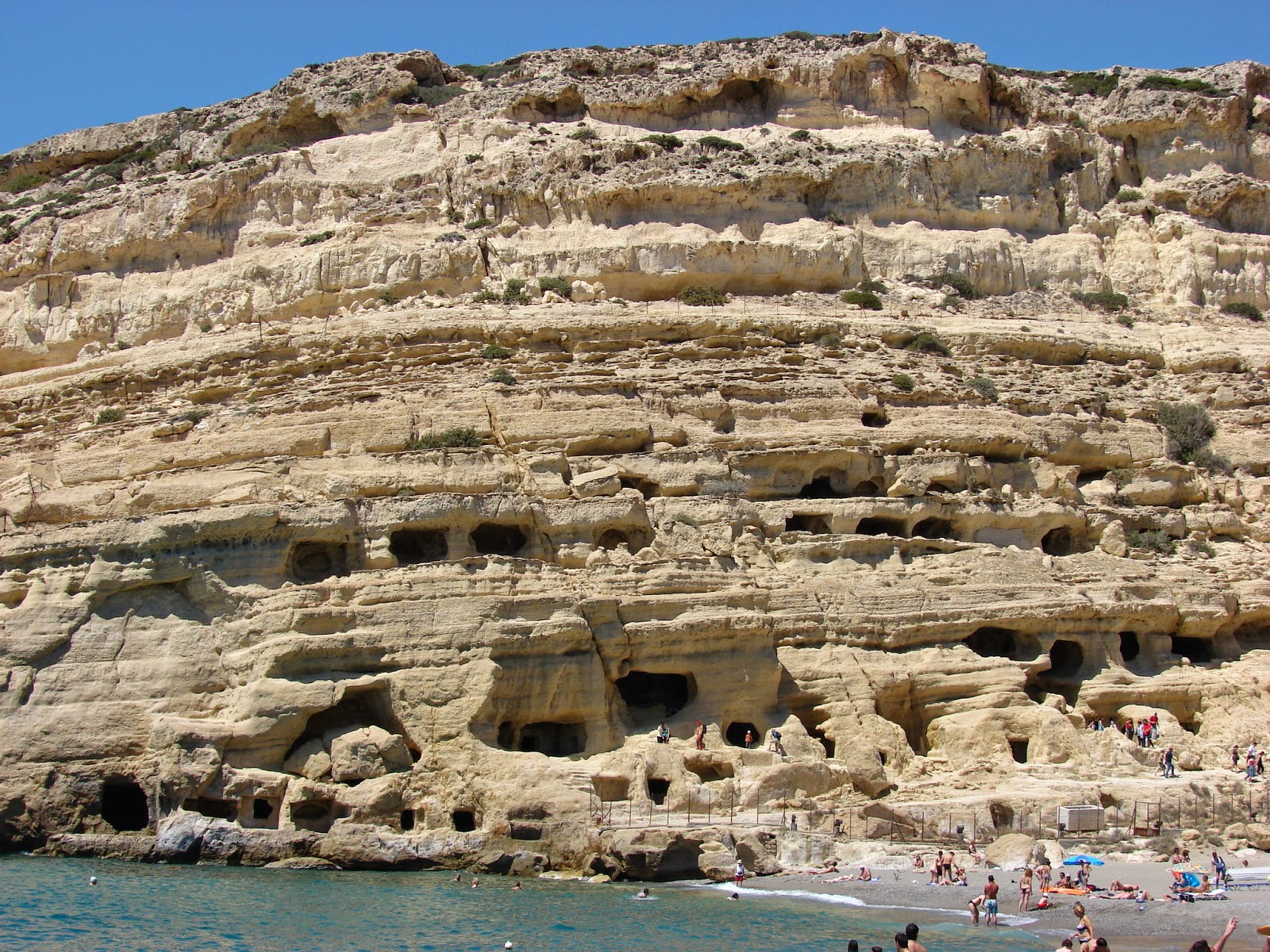
Famous beach Matala located 75 km south-west of Heraklion. Matala beach gained its popularity thanks to the clear and crystal sea and the rocks with pre-historic caves.

Beach is located near ancient city of Gortina and you can stop and rest here after your visit to this place. And right on the beach there are a few hotels. Not luxury but if you are late you can spend night there.

We need to say a little more about the caves on the beach. They were inhabited in the pre-historic times. Later, in the Minonian era, Matala beach served as the port for the Phaistos. When Crete was conquered by Romans they used the caves as the burial place.

And, like the Preveli beach, Matala in 1970-years was occupied by the hippie. Here was even shooted the “My Aunt the Hippie” and after the place was visited by “Rolling Stones” the beach became even more popular. Of course local were not happy to have hippie as their neighbors. They ousted the hippie and caves were declared as the National Archaeological Monument.

When I was on the beach the access to the caves was not restricted.

Matala beach located in the very convenient place. Local climate counted as one of the best on the Crete. The beach is restricted by the two rocks and thanks to this fact has own microclimate. And beach has spectacular view to the sea which is especially wonderful in the evening.

Matala beach very well equipped. Here you can find sunbeds, shower, cafes and restaurants.