Showing posts with label Spain. Show all posts

Wednesday, January 7, 2015

The Nativity Facade

Most impressive part of Sagrada Familia is a Nativity Facade. It seems, that Gaudi was intending demonstrate by it the all plastic power that could be achieved in Sagrada Familia.

The work under the Nativity Facade started in February 1894 and lasted until the end of the 20th century first quarter.

Four bell towers of facade were completed in 1929, their pinnacles in 1932. The work under the sculptures of facade continued during the next few years.

Photo Nativity Facade

The Nativity Facade has three porticos and four bells. Porticos are dedicated to the three canonical virtues. Central portico dedicated to the Charity, the portico of the right side dedicated to the Faith and the portico from the left is dedicated to the Hope.

The central portico is also called Love. The portico designed as if it is a big cave and depicts the scenes of Birth of Jesus

Tuesday, January 6, 2015

The Apse of Sagrada Familia

The Apse of Sagrada Familia has been constructed just after the completion of the temples crypt. Gaudi wanted to dedicate the Apse to the Virgin but it was dedicated to the Saint Joshep according to the wishes of the main sponsor of the project - Boccabella. It was designed in Gothic style but even in the rigorous Gothic the Gaudi's hand is appearing.

Photo Apse of Sagrada Familia

Thursday, August 14, 2014

Toledo

The city of Toledo - is a former capital of the Spain. It was founded in the pre-roman times of the Spanish history but during the Roman era Toledo hadn't played significant role. It was the ordinary city on the expanses of the Roman Empire.

Everything is changed for the city after the fall of the Western Roman Empire when in 534 it has been chosen by Goths as their capital. According to the evidences of the contemporaries of the city it quickly became one of the most developed cities in Europe with a big number of churches and palaces. But in 711 Toledo has been captured by the Moors which conquered almost all territories of the Spain.

View of Toledo. Photo provided by the Gaguilarq under CC BY 3.0 license

For survived Christian kingdoms at the north of the Spain Toledo always was the spiritual capital. They desperately tried to regain control over the city but only in 1085 their attempt was successful.

King Alphonse Sixth, who was commander of the troops, lifted his flag over the citadel of Toledo and after the three years he made the city his capital. As I already said Toledo was capital of Spain until 16th century when King Philip decided to move the capital to the Madrid.

Toledo became one of the richness towns of medieval Spain. It was the cultural, spiritual and scientific center of the country. Also it was adorned by the big number of magnificent palaces. Some historians say that King Philip left the city because it was to lavish for him. He had looked for the ascetic way of living and Toledo definitely was not a such city.

El Puente de Alcántara- Toledo. Photo provided by the Dan Vaquerizo Molina under CC BY 3.0 license

From the observation deck which is located on the highway to the Toledo you can notice that historical center of the city is small. The pass to the main gate of Toledo (The Gate of Sun) lies through the bridge of Alcantara. This ancient bridge has been built by the Romans and still in service. The bridge has two towers which were built later. The closest to the city tower was built in 13 century and another tower originated from the 18 century.

“The Gate of Sun” has been built in the 12 century by the Moors. But in the base there is Roman stonework. Nearby the gate there is castle of San-Servando which was erected by the King Alphonse Sixth to prevent possible attempts of the Moors to regain control over the city.

San Martin Bridge - Toledo. Photo provided by the Dan Vaquerizo Molina under CC BY 3.0 license

In Toledo there are a lot of churches. But the main spiritual building – is a famous Cathedral of Toledo. The Cathedral of Toledo was built over the Muslim church. In turn Moors church has been built over the old church of Goths. In 13 century the building was decayed and had stood in the poor condition. Also it was too small for the effuse city and could not hold all prayers.

In 1227 according to the order of the King Fernando the old building has been demolished and new construction began instead. The construction lasted 250 years and today Cathedral of Toledo is the one of most impressive buildings in the city.

Alcazar of Toledo. Photo provided by the José Luis Filpo Cabana under CC BY 3.0 license

After the Cathedral the most important monument in Toledo is an Alcazar which is deeply coherent with the history of the city. Built by the Romans Alcazar then was a Moorish fortress and in 1085 Alphonse Sixth chose it as his residence. Alcazar and Cathedral - are the main sights of the city. Next to them located most important buildings of Toledo. Surrounding quarters have the marks of the Moorish times. They could look plain outside but very lavish inside. Some houses even have gardens and medieval pools with fountains. I think you will have a lot of joy during your stroll on the streets of the city.

Toledo - Santiago del Arrabal. Photo provided by the EmDee under CC BY 3.0 license

Also Toledo is known as the city of El Greco. He was born on Crete, studied arts in Venice but got his fame in Toledo. You can visit a lot of places related with El Greco. For example, home where he lived and worked for a long period. Also in the city’s churches there are a lot of works of El Greco. If you don’t have enough time to explore them all don’t miss small San-Tome Church.

Also I advise you to visit the San-Martin Bridge from which you can make very nice photos of the city. Especially at night, when Toledo covered by millions of lights. So it’s better to stay in Toledo for a few days and explore the city without rush and bustle.

Mezquita Cristo de la Luz . Photo provided by the José Luis Filpo Cabana under CC BY 3.0 license

Friday, August 8, 2014

Segovia

Segovia is a small historical city located not far away from the Spanish capital. It has a lot of monuments of different cultures and different epochs and I think that Segovia is one of the most interest destinations in Spain for the tourists.

It’s also one of the oldest cities in Spain. Segovia has been founded around 700 BC. In the ancient times the prominent pages of its history were related with the name of Sertorius who tried to establish in the Spain independent realm from the Rome.

Segovia. Old Town. Photo provided by the Selbymay under CC BY 3.0 license

Sertorius was a talented general. Two years he acted successfully against Romans but frankly speaking he has not had enough resources to win the war. Even Hannibal has been defeated by Romans. One day he was betrayed by his followers (who were tired by the endless war) and was captured by Romans.

Romans have not destroyed the city. Instead, they have converted Segovia into one of the important centers in the Spain. They built a lot of buildings in the city such as the amphitheatre, forum and aqueduct.

Today about the Romans fame in the city reminds only the aqueduct. It’s hard believe but this aqueduct is still in use. It still supplies the water into the some districts of the city.

Aqueduct of Segovia. Photo provided by the Bernard Gagnon under CC BY 3.0 license

When the aqueduct has been built is unknown. Probably it’s happened during the reign of the Trajan at the end of the first century. Its height is 30 meters at the point of the maximum altitude and its length is 17 km. In the 11th century the aqueduct has been destroyed by the moors but when the Christians regained control over the city they restored it.

After the fall of the Roman Empire the fate of the Segovia was the typical for the Spanish cities. First who gained control over the Spain were the Visigoths. After a few centuries they have been expelled by the Moors and only a few Christian kingdoms survived in the north part of the Spain.

When Christians began to regain control over the territories, Segovia became one of the Spanish capitals. Spanish kings periodically lived in the city until 1570 when Philip Second moved the capital to the Madrid.

It was the golden era of Segovia. A lot of wonderful buildings were built in the city including the magnificent Alcazar of Segovia.

City walls of Segovia. Photo provided by the Bernard Gagnon under CC BY 3.0 license

The historical center of the city stands surrounded by the medieval walls. The walls as well as the gates into the city are in good conditions. Beyond the walls lays part of the city with narrow streets and preserved medieval planning. The heart of the historical center – is a Plaza Mayor with the Cathedral of Segovia.

The construction of the current Cathedral was started after the old Cathedral has been destroyed after the big fire in 1520. After the five years king Charles I ordered to build the new Cathedral in the city. The construction has been led by the famous Spanish Architect Ontanon who also has been responsible for construction of Cathedral in the city of Salamanca. The construction lasted a few centuries and Cathedral of Segovia has been consecrated in the 1768.

Cathedral of Segovia. Photo provided by the Carlos Delgado under CC BY 3.0 license

The Cathedral of Segovia is not only one spiritual building in the city. Here you can find a lot of mediaeval abbeys and churches. Many of them originate from 12-13 centuries and have been built in Roman style.

My favorite Roman church in Segovia - is a San-Millan church which has been built in the 111-1123. This church has a vestiges of the Moors culture (what is typical for the Spain). Its tower adorned by the magnificent and picturesque ornament of the Arabic style.

Another interesting church is San- Esteban which dates from the 13 century. The church of Vera Krus has been built by the Order of Templar Knights in the 1208 and was copied from one of churches in the Jerusalem. Of course I have not covered all the monuments in the city. Here a lot to see. I think the best way to become familiar with it it’s to spend a few days of your vacation here, in Segovia.

Segovia. Plaza de San Martín. Photo provided by the Bernard Gagnon under CC BY 3.0 license

Segovia. San-Millan. Photo provided by the Jebulon under CC BY 3.0 license

Segovia. San-Martin. Photo provided by the Jebulon under CC BY 3.0 license

Thursday, July 24, 2014

Avila

Avila, which stands in the surrounding of medieval walls, is very picturesque city. At the first glimpse, may seem that the Avila reminiscent of the one of the eastern cities. But when you approach to the city all memory of the East is dispersing with emergence of the endless number of medieval Christian churches.

Avila, the capital of the Spanish province, is most alpine city in the country. The city located at the altitude of the 1130 meters. The city already was known under the name of Ovila in the Celtiberians times. The fact that Avila in the ancient times was very important political and trade center can be traced by the numerous remains of these times such as sculptures and survived parts of the buildings.

Avila. Church San Pedro. Photo provided by the Selbymay under CC BY 3.0 license

In the 714 Avila has been captured by the Moors and after the three centuries it was gained by the troops of Raimundo de Borgonya. By the order of the Castilian king all Moors were evicted from the Avila and the city was populated by the famous families from the Leon, Asturias and Galicia.

Soon after, Avila become one the significant centers in the Castilia. During the long period Avila stood at the border between Moors and Christian and with the Salamanca the city was called as the “fortress of the Christian world”. Then Avila was the city-fortress and even today a lot of buildings in the central part of the city look like the citadel than the ordinary houses.

Avila. City Walls. Photo provided by the Yildori under CC BY 3.0 license

Avila often served as the residence of the Castilian kings. Also it was one of the popular pilgrim centers. Today the city has one of the best preserved medieval ensembles in Europe. Avila is very popular among the sightseers and tourists are huddling on the cities streets.

Avila sights

The main attraction of the city is the old fortress with 88 towers which stand after every 25 meters. Total length of the walls is 2526 meters. Today Avila is most powerful and best preserved fortress in Spain.

The oldest church in the town - is the small San-Andres church which originates from the 11 century. In the ornament of church you can see the influence of the masters from the North Spain and most probably this church has been built by the masters from Leon. Another prominent old church in Avila – is a San-Pedro which has been built in the 12 century.

Most prominent church of Roman style in Avila – is church of San-Vicente which has been built in the 12 century. According to the legend this church stands over the burial place of two saints. The construction of the church lasted during the century, so San-Vicente was finished in the 13 century.

Avila. Church of San Vicente. Photo provided by the Selbymay under CC BY 3.0 license

The façade of the San-Vicente differs by the sparse style and décor. For me, the most interesting are the scenes of fight between virtue and vice which can be seen on the south portal.

The church of San-Segundo (1519) has been built over the tomb of the Saint Segundo who baptized the city.

The Cathedral of Avila another prominent example of the church architecture of the city. Don’t miss the central altar of the Cathedral which was made from the walnut in 1555 by the Cornelius from the Netherlands. The nine chapels of the Cathedral were built in the different time and serve as the burial place for the prominent people of Avila.

In the Middle Ages Avila was called as the “city of stones and saints”. This city which stands in the stone area at the shore of the Adacha river – is the one of the focal centers of pilgrimage in Spain.

But Avila can boast not only by the church architecture. In the city you can find a lot of civilian buildings as well. For example, the Palace of Polentinos which has been built in the 1535. The patio of this building – is the best example of the Renaissance in the city.

Avila. Palace of Polentinos. Photo provided by the Dahis under CC BY 3.0 license

Another prominent examples of Renaissance in the city are Palace of los Aguilas and Casa de los Davila.

And to feel some bustle of the medieval city, after the exploring such places of tranquility as churches and abbeys, visit the central market of the city. It seems that the market still has east spirit. And prowling and huddling on the market is the best way to feel the spirit of the Middle Ages in the city.

Avila. Placa del Mercado . Photo provided by the Elena F D under CC BY 3.0 license

Wednesday, July 16, 2014

Alcazar of Segovia

Like other, Alcazar of Segovia has been built by the Moors although archaeological excavations show that it originates from the Roman fortress. This version could be confirmed by the fact that the Segovia existed in the Roman times and today we can see some Roman artifacts in the city.

First name of the fortress is unknown. First time in the documents it was mentioned as “fortress at the hill” but in 1155 fortress has been mentioned as Alcazar.

Today a little reminds about those times. Only portico on the north side of the castle and the Big Hall were preserved from the initial building.

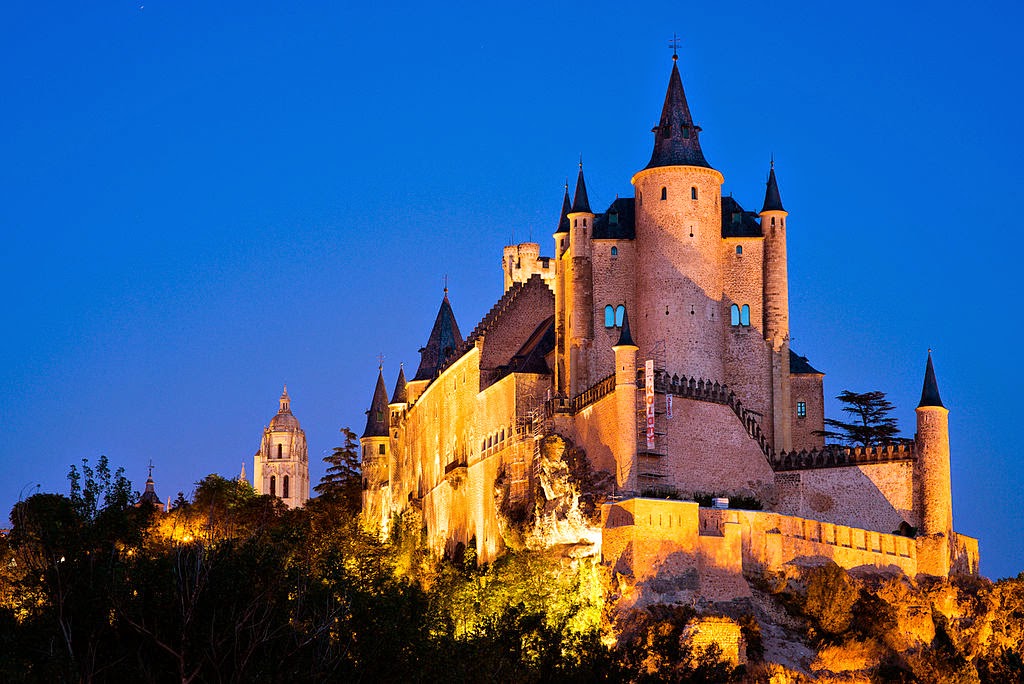
Alcazar of Segovia. Photo provided by the Fernando García under CC BY 3.0 license

Alcazar of Segovia located at the very beautiful place on the top of the hill at strategic point. It was built as the fortress but for centuries of its existence it was the royal residence, the military school and even the jail.

The view of Alcazar in the times of the king Alfonso 8 remains unknown. What we know, is that Alcazar was built from the wood. After the Alfonso and his wife queen Eleonora chose the castle for their residence instead of the wooden fortress began construction of the stone castle.

Alcazar of Segovia. Photo provided by the Macueo under CC BY 3.0 license

During the centuries the Alcazar of Segovia served the royal residence and the key fortress in the defensive system of the Castile. In 1474 castle played very important role in the history of Spain. When the news about the death of the king Enrike reached Castile Isabella (who was one of the pretenders for the throne) refuged inside the castle. After receiving the support from the citizens of Segovia she has been crowned in the Alcazar and became the queen of the Spain. Later she married for the king of Aragon and with this marriage the Spain was amalgamated.

Alcazar of Segovia. Photo provided by the PMRMaeyaert under CC BY 3.0 license

In the times of the reign of the king Phillip II Alcazar of Segovia was again rebuilt. But after Phillip chose Madrid as the capital of the Spain and his residence Alcazar of Segovia began to decline.

For two centuries the castle became the jail. Only in 1762 king Carl Third founded in the castle the Royal Military School. In the 1862 Alcazar of Segovia was badly damaged after the fire. For long time it stood in the bad conditions until it was refurbished in the 1882.

In the 1953 the Alcazar of Segovia became the museum. Today it’s the one of the main attractions of Segovia and one of the most visited places of Spain.

Alcazar of Segovia. Photo provided by the Selbymay under CC BY 3.0 license

Thursday, July 10, 2014

Salamanca

The city of Salamanca was founded by the Celtic tribe in the pre-roman times of the Spanish history. During the Punic War the city has been attacked by the troops of Hannibal. Later Salamanca became the part of the wide Roman world.

It was very important city of antiquity. According to the witness of Roman historian Polybius, Salamanca laid on the so called “Silver way” which connected the Mediterranean and the Spain.

But most of its glory Salamanca gained in the medieval times when the city got the name – “Golden city” because of its treasures and magnificent architecture.

In the beginning of the 8 century Salamanca has been conquered by the Moors. After the few centuries Christians re-gained control over the city. Most prominent event in the city’s history occurred in the 1200 when the king Alfonso Tenth founded in the city University, third in the Europe. Soon after the University of Salamanca became well known across the Europe and Pope Alexander Fourth even called it as the “luminary of the Christian world”.

Salamanca Spain. Photo provided by the Jiuguang Wang under CC BY 3.0 license

The University of Salamanca related with the most prominent names in the Spanish literature. For example, with name of Cervantes who lived in Salamanca and studied at the University. We can even say that the Spanish literature was born at this city.

Current building of the University originates from the 1433. In the 1529 Antonio Nebriha adorned façade of the University in the style of “plateresko”. This style got its name from the Spanish word “plato” (silver) and epitomizes the Spanish Renaissance in the architecture.

The complex of the University in Salamanca includes a few colleges, hospital and the library which consists from more than 160000 of medieval books and adorned by the magnificent frieze “Heaven of Salamanca”.

Salamanca Plaza Mayor. Photo provided by the Stef Mec under CC BY 3.0 license

The University in Salamanca also includes famous palace of the “Palacio Anaya” and the house of the Casa de las Conchas which is the one of the symbols of the city. The walls of this house adorned by the sinks carved from the stone. And this is why this house got its name because the “Conchas” from the Spanish could be translated as the sink. Opposite of this building you will find the abbey of the La-Clersia which has been built in the 17 century.

After the walk through the University complex and the its surroundings it’s time to visit the central square of the Salamanca – the Placa Mayor. This square originates from the middle of the 18 century and reckoned as the one of the most beautiful in the Spain.

Nearby there are a lot of monuments among which stand out the Old and New Cathedrals.

Salamanca New Cathedral. Photo provided by the Jentges under CC BY 3.0 license

The Old Cathedral of Salamanca has been built in the 12 century. To get inside it’s possible only from the New Cathedral which originates from the 16 century. Today the Old and New Cathedral is the one complex and for those who do not know that these different buildings, it’s very hard to secede one from another.

Among the treasures of the New Cathedral there is legendary cross which had been used by the El Cid when he fought with Moors. Also about the times of Reconquista in Salamanca reminds the castle of Clavero which originates from the 15 century.

And yet the Salamanca more famous for its beautiful palaces and churches. For example, the palace of Salina which dates from the 16 century. This palace is one of the most prominent palaces of Renaissance in the Spain.

It’s worth mentioning about the narrow streets of Salamanca which give special charm to the city. It’s the places where blended the history and modernity. You can wonder these streets endlessly and every time discover something new about this magnificent city in Spain.

Salamanca Casa de las Conchas. Photo provided by the Paelb under CC BY 3.0 license

Salamanca Palace of Muertes. Photo provided by the Piutus under CC BY 3.0 license

Salamanca Palace Salina. Photo provided by the Alejandro Moreno Calvo under CC BY 3.0 license

Salamanca Cafe Novelty. Photo provided by the Pravdaverita under CC BY 3.0 license

Monday, July 7, 2014

Caceres

Caceres (the city located south-west from the Madrid) is a quite modern city with the wide boulevards, highways and modern blocks but in the heart of the city, in the surrounding of the medieval walls, lays old center of the Caceres which in Spain can contest with Toledo.

The well preserved historical center of the Caceres differentiates by the variety of the architectural styles of the 8-17 centuries and pertains to the most beautiful cities of the Europe.

Caceres originates from the 34 BC. In the Middle Age the city played important role in the wars between Moors and Christians. In the 12 century the Moors fortified the city and built strong walls around it with a lot of the loopholes and strong stonework. In the 1229 the city was conquered by the king Alphonse Ninth and became the part of the Castilian kingdom.

Caceres Spain Plaza Mayor Arco. Photo provided by the Jsanchezes under CC BY 3.0 license

Historical center of the Caceres located at the hill in surrounding of the walls with the 12 towers and 5 gates. The main part of this defensive system has been built by the Moors but in the some places you can notice the vestiges of the Roman work. The oldest buildings located in the east part of the walls. It’s the Tower of the Cross (originates from the first century) and the Tower of the Council (originates from the second century).

Usually sightseers start their walk on Caceres from the local Placa Mayer in the east part of which there are ancient towers and walls. At the square there is a staircase which can lead you to the gates of the Arco de Estiliya.

From this gate you can pass to the square of Santa Maria which is the heart of the medieval town. The main monument of this place – is the city’s cathedral which shares the name with the name of the square. This cathedral has been built in the Gothic style but of course in its guise there are elements of the others styles.

Caceres Spain Plaza Santa Maria. Photo provided by the GianniG46 under CC BY 3.0 license

In opposite of the cathedral you can find a few palaces. For example, the Casa of Carvackal which was built in the 15 century or the Bishop's Palace which originates from the 1567.

The second square of the Caceres which is very popular among the tourists it’s the square of the Santa Chorche. This place looks differently from the square of the Santa Maria. The dominant color here – the bright white. The square surrounded by the mansions of the Renaissance style. Also don’t miss the old abbey of the San-Francisco which originates from the 17 century. In the north part of the square there is mansion Golfinos de Abacho (15 century) in which lived royal pair of Ferdinand and Isabella when they visited the city.

Another noticeable part of the city – is the Velates square. Initially here was the located the city’s citadel (in the Spain it’s called Alcasar) but today you will find the palace of the Velates in place of it. This palace hosts the city’s museum. If you don’t hurry up, please, visit this museum since it has a lot of interesting artifacts.

Caceres Cathedral. Photo provided by the Olarcos under CC BY 3.0 license

Saturday, June 14, 2014

Loarre Castle

Loarre Castle (located in Spain near the border with France) reminds about the times when the first Christian kings fought with moors for the Spain. In fact, it was the last Christian stronghold in the Spain and from this point they started the process which is known in history as Reconquista (liberation the Spain from the moors)

Moors invaded the Spain at the beginning of the 8 century. They very quickly gained control over the country and only the few Christian kingdoms survived at the north of the Spain. One of them was the Aragon which there of could be counted as the cradle of the Spain.

Loarre Castle. Photo provided by the Antonio under CC BY 3.0 license

Loarre Castle – is an oldest fortress in the Spain. The current castle was built in the 10 century over the ruins of the Roman fortress. In the 1065 castle was took by the Moors but has been liberated soon and after that has been fortified even more.

By the Spanish tradition the Loarre Castle was not only the fortress but also the monastery. So, it’s not wonder that central place in the castle was reserved for the church.

Loarre Castle. Photo provided by the Ecelan under CC BY 3.0 license

It’s worth mentioning that castle located in the very amazing place and has been chosen by the kings of Aragon as their residence. Recently in the castle were discovered graceful murals and beautifully decorated reliefs. There of we could make a conclusions that castle was important royal residence in the Middle Ages.

But we should admit that the heyday of the Loarre didn’t last for along period. Kings of Aragon built another residence some day and Loarre Castle has been abandoned.

In the 13 century castle was fortified again. But when Christians got control over the north and central Spain, Loaare lost its military importance. Today the castle is a very nice museum which remains us about the vigorous fights here in the Middle Ages.

Loarre Castle. Photo provided by the Millars under CC BY 3.0 license

Tuesday, June 10, 2014

Placa Real Barcelona

It’s one of the secret places in the city. Placa Real in Barcelona huddles to the Gothic Quarter and La Rambla. It’s very easy to miss it when you walk along the boulevard and I found it only from the second attempt.

The square was built in the middle of the 19 century in place of old monastery. It was the times in Spain when the Church was separated from the State and many of the old churches and monasteries in Spain were demolished.

Placa Real Barcelona. Photo provided by the AndriySadivskyy under CC BY 3.0 license

Placa Real has been built very quickly but its decoration was postponed for a time. And I think it’s was a judicious decision from the city’s authorities because this work in the future was assigned to the young Gaudi.

I think that is why the Placa Real today could be reckoned as one of the graceful places in the Barcelona.

Placa Real Barcelona at night. Photo provided by the Serge Melki from Indianapolis, USA under CC BY 3.0 license

Friday, September 28, 2012

Monastery of Poblet

Monastery of Poblet is a unique example of the middle ages architecture. The complex was in the one moment the abbey, the fortress and the royal palace. Later the Monastery of Poblet was converted to the pantheon of the royal dynasty of the Aragon kingdom.

Located the Monastery of Poblet in the Spain, not far from the city of Tarragona. (the distance is about 20 kilometers). A monastery situated in the wonderful place in the surrounding of the vineyards.  Also near the monastery start few mountain routes so if you like walking you can enjoy this activity during your visit of Poblet.

Monastery of Poblet recently was restored (it was demolished in the middle of the 19 century)  and now Poblet has very good conditions. I personally was impressed by the inner courtyard of the monastery with small garden and beautiful fountain. The main church of the monastery is breathtaking too with its 14’s century altar and the lines of royal tombs.
I can mention only one lack of the monastery. You can pass inside the monastery only with excursion. It’s not the problem but the problem that the excursions only in Spanish or catalan languages.

The King’s Gate of Poblet

The main entrance to Poblet is the King’s Gate. It’s a significant example of fortifications of 16 century. Over the main arch you can see the Catalonian kings’ coat of arms which is supported by angels and lions. Near the king’s insignia you can read the king’s motto which claims that this building was built during the king Pedro of Aragon reign.

The flawless stonework, façade, loopholes turn this gate into the magnificent example of military architecture.

The Courtyard of Poblet

The nice gate in the Romanic style leads to the Courtyard of Poblet. The kluatr of Poblet is the yard with portico and with the beautiful garden in the center. The oldest galleria was built in the 12 century. Others were built a century after. Also in the middle of the yard you can see the magnificent fountain which as a gallerias belongs to the Romanic style.

The main church of Poblet

The main church of Poblet was built keeping up the canonical traditions. It has three naves which separated one from another by columns. Two from three naves belong to the Romanic style and one to the Gothic style. The main altar of the church is a stone slab which was placed here from the monastery beginning.

The main church of Poblet is the royal shrine of Catalonian kings. Here, for example, there is the sarcophagus of famous Pedro Conqueror who enlarged the Catalonia to the maximum borders.